


Evidence suggests that newborn and child health systematic reviews and meta-analyses exhibit poor quality in reporting. The Preferred Reporting Items in Systematic Review and Meta-Analysis’ (PRISMA) guideline has been developed to improve the reporting of systematic reviews. We aimed to identify areas where reporting could be strengthened, underpinning a rationale for the implementation of child-centric extensions and modifications to the current PRISMA to improve reporting in this population.
We developed a consensus-based checklist of essential items which researchers should include when reporting systematic reviews (SRs) of interventions in pediatrics. The PRISMA-Children and Adolescents (PRISMA-C) 2026 guidance will 1) help authors write clear reports of their systematic reviews of interventions in pediatrics, 2) create a framework for reviewers that assess publications, 3) expedite funding evaluations, 4) provide a tool for training students and researchers on paediatric SR methodology, and 5) help end-users of the SR such as paediatricians and policy makers to better evaluate SR’s validity and applicability in their decision-making process.
The PRISMA-C 2026 extension comprises 7 reporting items, 4 abstract items, and 10 items in which the ontogeny statement applies. The Statement and Explanation has been published as one paper in The BMJ. The link to the publication is available below.
The Statement and Explanation paper has been published in The BMJ:
Downloadable, fillable checklist:
- PRISMA-C 2026 (PDF)
Systematic review: Farid-Kapadia M, Joachim KC, Balasingham C, Clyburne-Sherin A, Offringa M. Are child-centric aspects in newborn and child health systematic review and meta-analysis protocols and reports adequately reported?-two systematic reviews. Syst Rev. 2017 Mar 6;6(1):31. doi: 10.1186/s13643-017-0423-9. PMID: 28260528; PMCID: PMC5338085.
Debate paper: Farid-Kapadia M, Askie L, Hartling L, Contopoulos-Ioannidis D, Bhutta ZA, Soll R, Moher D, Offringa M. Do systematic reviews on pediatric topics need special methodological considerations? BMC Pediatr. 2017 Mar 6;17(1):57. doi: 10.1186/s12887-017-0812-1. PMID: 28260530; PMCID: PMC5338083.
Previous protocol: Kapadia MZ, Askie L, Hartling L, Contopoulos-Ioannidis D, Bhutta ZA, Soll R, Moher D, Offringa M. PRISMA-Children (C) and PRISMA-Protocol for Children (P-C) Extensions: a study protocol for the development of guidelines for the conduct and reporting of systematic reviews and meta-analyses of newborn and child health research. BMJ Open. 2016 Apr 18;6(4):e010270. doi: 10.1136/bmjopen-2015-010270. PMID: 27091820; PMCID: PMC4838710.
Editorials and commentary about PRISMA-C:
Gordon M, Raman S, Woolfenden S. The limits of reporting checklists in paediatric research. BMJ. 2026 Jun 11;393:e164303. doi: 10.1136/bmj-2026-164303. PMID: 42276567.
Baba A, Heus P, Hooft L, Offringa M. Responsible Research Practices in Pediatrics: How Reporting Guidelines Can Be Used to Improve Trial Design and Conduct. J Pediatr. 2026 Jul 1;297:115218. doi: 10.1016/j.jpeds.2026.115218.
Baba A, Farid-Kapadia M, Smith M, Hartling L, Moher D, Hooft L, Offringa M. PRISMA-Children and Adolescents (PRISMA-C) 2026 extension statement and explanation: enhancing the reporting and utility of systematic reviews of interventions in paediatrics. BMJ 2026;393:e088561. doi: 10.1136/bmj-2025-088561
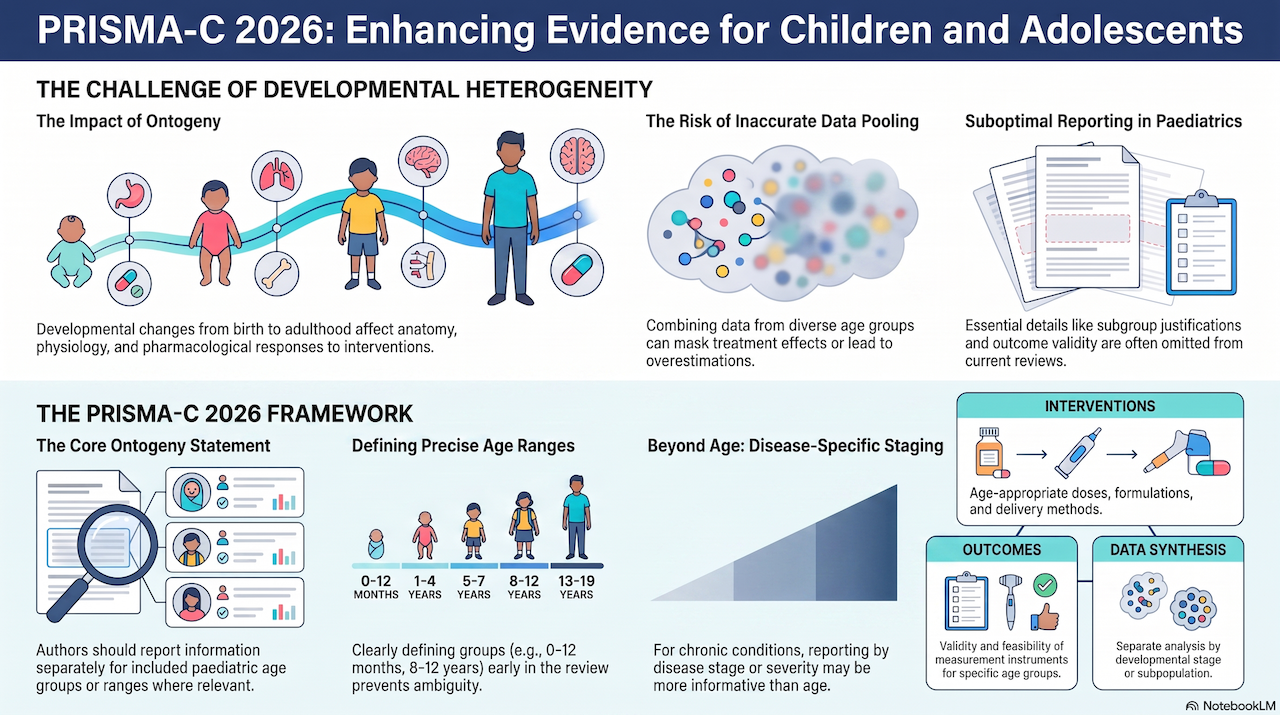
Explainer video:
This project was supported by the Canadian Institutes of Health Research (CIHR), the CIHR Strategy for Patient-Oriented Research (SPOR), and the Ontario Child Health Support Unit.
Logo designed by Matthew Prebeg
Updated September 2026