
Fitness to Aid the Brain and Cognitive Skills
What is being studied?
With recent advances in medical treatment, many children diagnosed with brain tumours are cured. There are currently over 3000 survivors of paediatric brain tumours in Canada. However, children treated for a brain tumour often have learning problems. We did a 12-week hospital-led exercise program and found that physical exercise can help the brain and improve motor and thinking skills in children treated for a brain tumour. We also received very positive feedback from families.
Now, we want to see if a community-led exercise program can have similar results. Dr. Mabbott is leading this study to test the feasibility (i.e. does it work?) of a community-led exercise program aimed at helping the brain recover from injury in children treated for a brain tumour. We will be using cognitive (thinking) tests and brain scanning as part of this study.
What will my child need to do?
The study includes two types of visits:
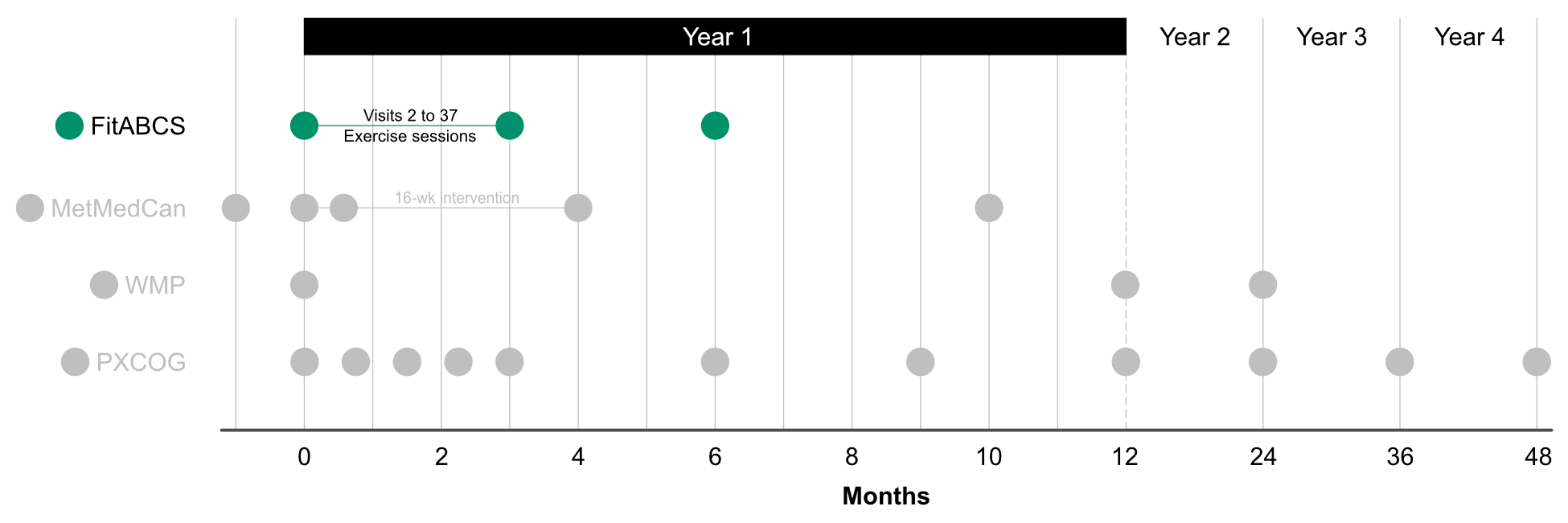
- Exercise sessions. 12-week group exercise program in the Greater Toronto and Hamilton Area (GTHA), consisting of 3 sessions per week. Each session will be 1.5 to 2 hours in length.
- Study assessments. At 3 points throughout the study, we will ask you and your child to come to SickKids for a study visit.
For further descriptions, look through below:
The program will involve your child doing exercise so that your child’s heart beats faster, they breathe harder, and their muscles get stronger.
Activities will include fun games such as those they would play in gym class or on the playground. Sports/games (such as soccer, floor hockey, basketball, or dodge-ball) and physical activities (such as jogging, running relays, or obstacle courses) will be played in the program.
Your child will wear a heart rate monitor which will record how fast their heart is beating during the exercise program. This information will be sent back to SickKids to monitor your child’s progress.
Study visits will consist of: (1) MRI, (2) MEG, (3), physiotherapy assessment (4) fitness testing, (5) cognitive (thinking) testing and (6) quality of life questionnaires.

- A scan of their brain using Magnetic Resonance Imaging (MRI – no contrast). Your child will be asked to lie very still in the MRI scanner while we take pictures of their brain. The risks of MRI brain scans are very low. These brain scans do not involve radiation like the X-Rays your child may have had if they had broken a bone (~60 minutes).

- Magnetoencephalography (MEG) scanning will also be done. This is a non-invasive/harmless technique that records your child’s brain activity (~60 minutes).
Some children may not like lying down in the MRI or MEG machines. If your child becomes upset in the scanner, we will stop the imaging. A technician will be in the imaging suite with your child at all times during the scanning in order to help them.
- A physiotherapy assessment will measure their motor skills (i.e., balance, coordination, and strength) (~60 minutes).
- A fitness test will measure how hard their heart is working. They will ride a stationary bike and wear a heart rate monitor. They will also do a test that measures the distance they walk in 6 minutes (~60 minutes in total).
- A number of thinking games: tasks related to intelligence, attention, memory, and the speed with which they can solve problems (~ 60 minutes).
- You will be asked to answer questions about your child’s psychological (mental), social and physical well-being, as well as physical activity (~30 minutes).
- Exercise sessions
The program will involve your child doing exercise so that your child’s heart beats faster, they breathe harder, and their muscles get stronger.
Activities will include fun games such as those they would play in gym class or on the playground. Sports/games (such as soccer, floor hockey, basketball, or dodge-ball) and physical activities (such as jogging, running relays, or obstacle courses) will be played in the program.
Your child will wear a heart rate monitor which will record how fast their heart is beating during the exercise program. This information will be sent back to SickKids to monitor your child’s progress.
- Study assessments
Study visits will consist of: (1) MRI, (2) MEG, (3), physiotherapy assessment (4) fitness testing, (5) cognitive (thinking) testing and (6) quality of life questionnaires.
- A scan of their brain using Magnetic Resonance Imaging (MRI – no contrast). Your child will be asked to lie very still in the MRI scanner while we take pictures of their brain. The risks of MRI brain scans are very low. These brain scans do not involve radiation like the X-Rays your child may have had if they had broken a bone (~60 minutes).
- Magnetoencephalography (MEG) scanning will also be done. This is a non-invasive/harmless technique that records your child’s brain activity (~60 minutes).
Some children may not like lying down in the MRI or MEG machines. If your child becomes upset in the scanner, we will stop the imaging. A technician will be in the imaging suite with your child at all times during the scanning in order to help them.
- A physiotherapy assessment will measure their motor skills (i.e., balance, coordination, and strength) (~60 minutes).
- A fitness test will measure how hard their heart is working. They will ride a stationary bike and wear a heart rate monitor. They will also do a test that measures the distance they walk in 6 minutes (~60 minutes in total).
- A number of thinking games: tasks related to intelligence, attention, memory, and the speed with which they can solve problems (~ 60 minutes).
- You will be asked to answer questions about your child’s psychological (mental), social and physical well-being, as well as physical activity (~30 minutes).
Who can participate in this study?
Your child can take part in the study if they:
- Are between 6 and 17 years of age
- Have been diagnosed with a brain tumour
- Are 1 to 15 years since diagnosis
- Are medically stable (i.e., must be in remission)
- Have either English as their native language or have had at least two years of schooling in English
- Have a parent or legal guardian willing to answer questions about their child’s health and quality of life
Your child cannot take part in the study if they:
- Have been diagnosed with a neurodevelopmental or neurological disorder, cerebral palsy, developmental delay or learning disability before their brain tumour diagnosis
- Are receiving palliative care
- Need sedation for brain scanning
- Have any metal parts in their body (e.g., cochlear [ear] implant, braces). Note that some dental fillings and retainers are acceptable.
- Are pregnant
- Took part in any cognitive rehabilitation intervention within three months before starting this program
Reimbursement
- Reasonable out of pocket expenses, which may include:
- Some transportation costs (e.g., mileage, public transportation, parking) for exercise sessions and visits to SickKids
- Meals during study visits to SickKids
- $15 gift card after study visit(s)
- Volunteer certificate (if applicable)
Contact Elizabeth Cox (PhD candidate) for more information about the study.
- email: fit.abcs@sickkids.ca
- phone: 416-813-1500 ext. 328779
Study timeline
Thank you for reading!
If you’re interested in participating or have any questions, please email/call with the address/number above or use the form below.